
Network planning and expansion is a complex undertaking: increasing data volumes, rising quality standards, and the need to eliminate dead zones quickly and cost-effectively and to bring broadband service to underserved areas.
To ensure that mobile and broadband coverage can be improved nationwide, complex planning and deployment processes must be efficiently and precisely coordinated.
In practice, this means that decisions regarding locations and areas must be made more quickly, technical feasibility must be assessed early on, and planning risks must be minimized—ideally before costly steps are taken.
Challenge
Better to plan than to build expensively
To expand mobile and broadband coverage comprehensively and efficiently, companies must systematically optimize their complex planning and deployment processes. In the day-to-day practice of network planning, one thing is particularly crucial: a robust, company-wide database that enables precise analyses and supports sound decision-making—for example, when selecting and evaluating new cell tower sites or areas for fiber-optic expansion.
A central, reliable geodata repository serves as the foundation: it ensures transparency, enables realistic planning scenarios, and supports data-driven decisions when planning new cell tower sites or fiber-optic networks.
- As a Gold Partner of Esri, we leverage cutting-edge Esri technology to provide the necessary data, platforms, and applications for implementing data-driven, transparent, and scalable network and site planning—thereby sustainably improving our customers’ planning reliability, efficiency, and cost-effectiveness.
Implementation
3D Geodata and Esri Technology: The Foundation for Future-Proof Network Planning
To plan fiber-optic networks efficiently and cost-effectively, it is particularly useful to have data on parcels of land, building perimeters, and a comprehensive address database that includes the number of residential and commercial units.
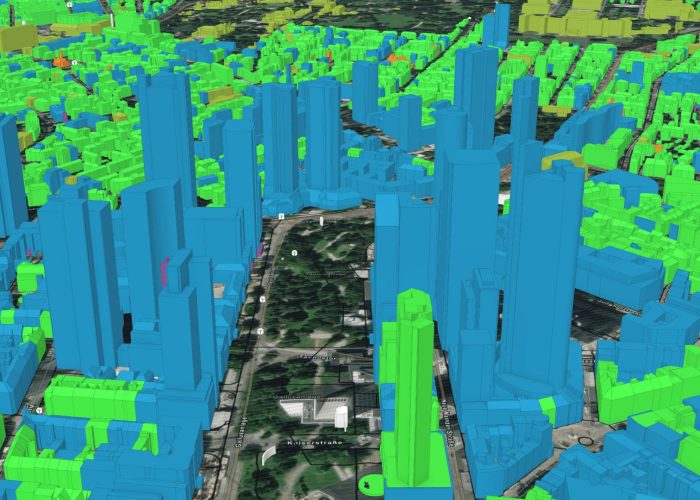
To identify new and effective cell tower locations, the following is also required: LOD2 building data, as this provides detailed information on roof shapes and building geometries—a key factor in the planning process for potential cell tower sites. The data is provided centrally, in real time, and can be visualized in 3D. A key benefit for customers is the ability to seamlessly integrate this data into existing ArcGIS environments. This eliminates the need for additional administrative effort related to updates or data maintenance. As a result, planning processes are accelerated, cost calculations are improved, visibility analyses are enabled, and relevant building attributes can be filtered quickly and intuitively during mobile network planning.
-
Geometric demarcation: Parcels are precisely delineated on maps and document the exact location, shape and size of a property.
-
Link to owner data: In the real estate cadastre, each parcel is linked to the corresponding owner information and possible encumbrances (e.g. rights of way, easements).
As a specialized provider of geographic and market data as well as geospatial analytics, we support these projects as a technology and data partner.
To meet these requirements, we are therefore able to implement a comprehensive solution within Esri’s ArcGIS environments. In summary, this means:
Centralized data provision
- Use the Data-as-a-Service license for ArcGIS Enterprise to provide parcels, building outlines, address points, and LOD2 data nationwide as 3D scene layers.
- Integration of a precise locator based on the company's proprietary Nexiga Geocoder for fast and convenient searching for parcels.
Integration into the customer's system environment
- Hosting the data in the Nexiga environment with direct integration into the customer's ArcGIS Online.
- No local data import, no updates, and no maintenance required on the customer's end.
Application-oriented maps & scenes
- Development of custom maps and 3D scenes that combine Nexiga data with customer-provided data and content from the Esri Living Atlas.
- Development of a specialized application, e.g., for evaluating potential cell tower sites, including:
-
- Line-of-sight analyses to assess sightlines and identify potential obstacles,
- Filter options by building height, roof shape, and type of use,
- Convenient parcel search via an integrated locator widget.
DaaS in ArcGIS: Simplifying Complex Planning Processes for Mobile and Broadband Expansion
The combination of high-quality geographic and market data from Nexiga and powerful Esri technology enables a high-quality, data-driven location analysis:
- Significantly more efficient planning of new infrastructure sites.
- Cost savings through more accurate analyses and high-quality geocoding.
- A unique market offering for evaluating potential cell tower sites and conducting area analysis—unavailable in this form until now.
- Comprehensive support ranging from site analysis to the optimization of operational and expansion strategies in the telecommunications sector.
Make decisions faster, expand efficiently:
- The customer's internal layers are visualized in their own GIS system (e.g., ArcGIS Enterprise, QGIS, or GeoServer) alongside the external Nexiga DaaS services— without any data exchange.
- Reduces the load on local resources, as there is no need to store large amounts of data—such as parcel data or LOD2 data—locally.
- High performance thanks to tiled, preprocessed data optimized for different zoom levels.
- No unnecessary effort for data imports or updates.
- Savings on external costs, such as by avoiding the need for additional "credits," since the service already includes all steps.
Our DaaS solution provides a scalable, future-proof approach to data and analytics that delivers lasting value to businesses and meets their specific needs.
Would you like to find out more?
We look forward to inspiring discussions about LoD, fiber-optic planning, and broadband expansion!

Get your free ticket —contact us!
fiberdays March 25–26, 2026
Booth 3.1 B 29, Messe Frankfurt
Take the opportunity to discuss precise parcel data with us as a key component for successful broadband expansion!
- We provide access to a complete building database with information on households, broadband availability and infrastructure.
- We provide efficient decision-making and planning aids for optimal fiber optic routing - including parcel data for legally compliant and cost-efficient network planning.
- We promote the exchange of experts by integrating additional data into your expansion projects.