Data quality beats quantity
ERP and CRM systems are usually central information and data hubs within the company that bundle both the company's data and its customers' data (data management). In addition, there is a virtually unlimited number of external data producers of all kinds. The search and purchasing behavior of customers, for example, can be observed and analyzed from a wide variety of perspectives. And this goes far beyond the activities in your own store. This allows companies to tap into new target groups and buyer types or address existing ones more precisely.
However, a company can only be successful if the quality of the data used is right. The information must really be relevant and verifiably deepen the description of a customer in a CRM or ERP system. It must also have reliable parameters, for example by being permanent, up-to-date, available across the board and flexible to use.
Data quality - the most important factors at a glance
- The data used must be relevant to the business and significantly deepen customer understanding.
- High-quality data always meets data protection requirements, such as the GDPR.
- The visualization of geodata in particular, but also of other data, makes "data-heavy" issues clear.
- Intelligent data analysis tools and solutions are no substitute for consultative discussions with data experts.
- Open communication: What can the available data do - and what not?
- The data offered must have undergone a basic quality assurance process before being used (e.g. technical checks using algorithms, validation, continuous updating).
Understanding data visually
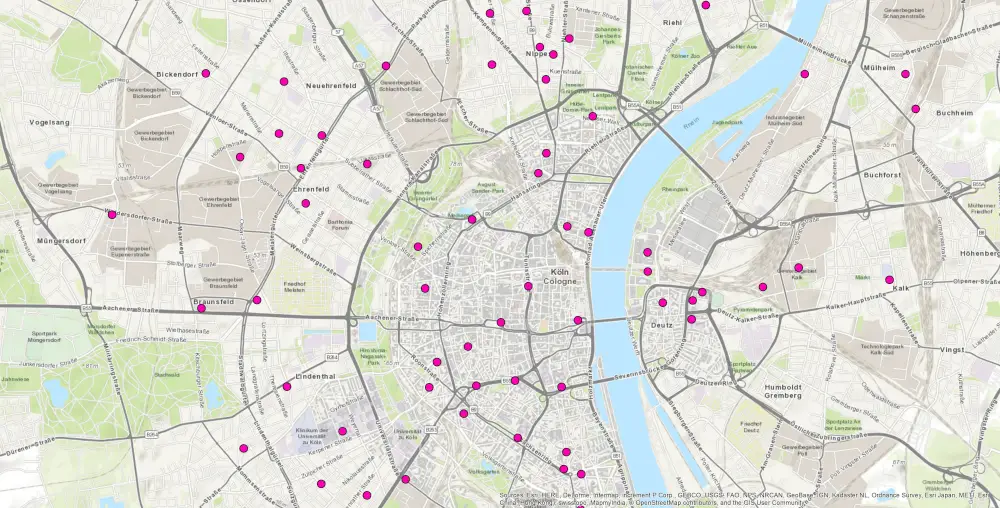
The visualization of data plays a central role. data. As we all know, a picture is worth a thousand words. Importing internal company data as well as external potential data into a geographical information system (GIS) enables the spatial analysis of market potential, for example.
Modern dashboards combine the graphical and tabular presentation with the map. Together with the customer, the Nexiga experts gain an understanding of the respective market situation. They also develop starting points for data-driven measures.
Data protection as a hurdle?
None of this replaces the intensive consultation between the customer and the data experts, especially at the start of a project. It highlights possibilities and examines certain issues for their potential business contribution. The tools planned for use should also be put to the test first. As a rule, Nexiga customers can test software and data solutions at the start of a project and before purchasing them in order to avoid bad investments.
Open communication with the customer is particularly important in order to establish effective expectation management. After all, the desired data and solutions should also deliver what the customer expects of them. It must also be clearly communicated what is not possible: for example, data cannot always be "up to date". Sometimes they are also not available in certain levels of detail - for example, if data protection reasons prevent this. The customer needs to know as early as possible what is possible and what they will receive. In order to make a lot possible here despite data protection, Nexiga works with derived "affinities" and "scores" in addition to the large amount of real information. On the one hand, they provide reliable information and, on the other, they fully comply with data protection requirements.
The data offered goes through a wide range of quality processes before it leaves Building . They are checked, validated and always kept as up-to-date as possible. The aim is to automatically detect anomalies, syntax errors, outliers, inconsistencies or conspicuous homogeneities in data characteristics and analyze them using intelligent algorithms. Nexiga relies on extensive routines from various software solutions. These include the SQL Server Management Studio, the analytics software solutions from SAS, the ArcGIS platform from Esri and the visual analytics platform Tableau.
Geo keys create customer and market transparency
In addition, Nexiga localizes data via geocoding and address validation processes and provides them with geo-keys. These geo-keys represent unique spatial indices that enable a link to the Nexiga database. Enrichments ultimately provide a client company with a new, expanded and differentiated picture of its existing and potential customers as well as additional market potential.
What is the really valuable data?
What's more: Only with high data quality is it possible to filter out the information that is really relevant to the business. Quantity is not the same as quality. It's about finding the really valuable parameters for greater market transparency. Take geodata, for example: The basis for high data quality here is postal addresses, official spatial layers and exact geo-coordinates. Nexiga brings together a wide variety of data sources and is always able to provide its customers with validated and up-to-date address quality for a wide range of issues.
The quality of the addresses is crucial to success in two respects: on the one hand, the addresses are used for all forms of spatial analysis and, on the other, they are the key to enriching the data with descriptive information and from other data worlds. Then there is data protection. Data quality is only guaranteed if the legal data protection requirements are met as standard. In accordance with the General Data Protection Regulation (GDPR), all data must be processed and evaluated anonymously and therefore not personalized.
Many projects are based on spatial issues. These can be issues relating to location or sales planning, target group definition or advertising management (demographic targeting). On the one hand, this includes the information available to the customer, such as branch locations or customer addresses. These are combined and analyzed in combination with, for example, socio-demographic descriptions, product-specific purchasing power or competitive information. Location intelligence methods are also used - such as the visualization of all data with a spatial reference. This visualization makes "data-heavy" and more complex issues easier to understand.