Small court, big hype
New year, new sporting resolutions: 2026 is the perfect time to discover padel tennis. This trendy sport combines tennis with wall play, is easy to learn, dynamic, and is usually played in doubles. No wonder padel is also growing rapidly in Germany—with over 330 locations and around 900 courts, mainly in cities.
Especially in the north, with Hamburg at the forefront, people are already swinging their padel rackets in many places.
Target audience and core personas
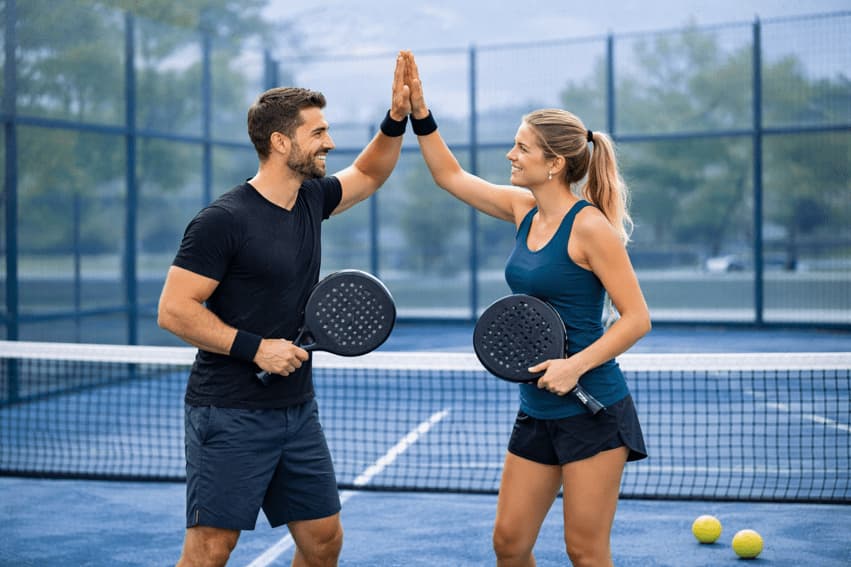
Padel tennis appeals primarily to active adults between the ages of 25 and 55 in Germany. Many players already have experience in tennis, squash, badminton, or fitness, but are looking for a more social and less technically demanding alternative. The proportion of beginners and those returning to the sport is correspondingly high. Thanks to its ease of learning, even sporting novices can quickly get to grips with it. At the same time, more and more clubs, companies, and fitness-oriented groups are discovering padel as a communal sporting activity.
A large proportion of the target group lives in urban areas, is employed, has a stable income, and is open to new leisure and trend sports. Padel is particularly attractive to people who want to combine exercise, fun, and social interaction —not least because it is almost exclusively played in doubles.
The central core persona in the German padel market—i.e., a specific, fictional individual who represents part of the target group—can be defined as the "urban recreational athlete. " This persona is between 30 and 45 years old, male or female, lives in a large city or in a suburban area (e.g., Berlin, Hamburg, Munich, or Cologne), and has an academic or professional qualification with a medium to good income.
She has often been or still is active in racket sports or fitness activities. Due to limited free time , she is looking for a flexible sport that can be easily integrated into her schedule —for example, as an after-work activity or on weekends—but still offers quick results. She is trend-conscious, uses digital booking and sports services, values experience, community, and quality, and lives a health-conscious lifestyle without being performance-oriented. Padel tennis meets these needs perfectly.
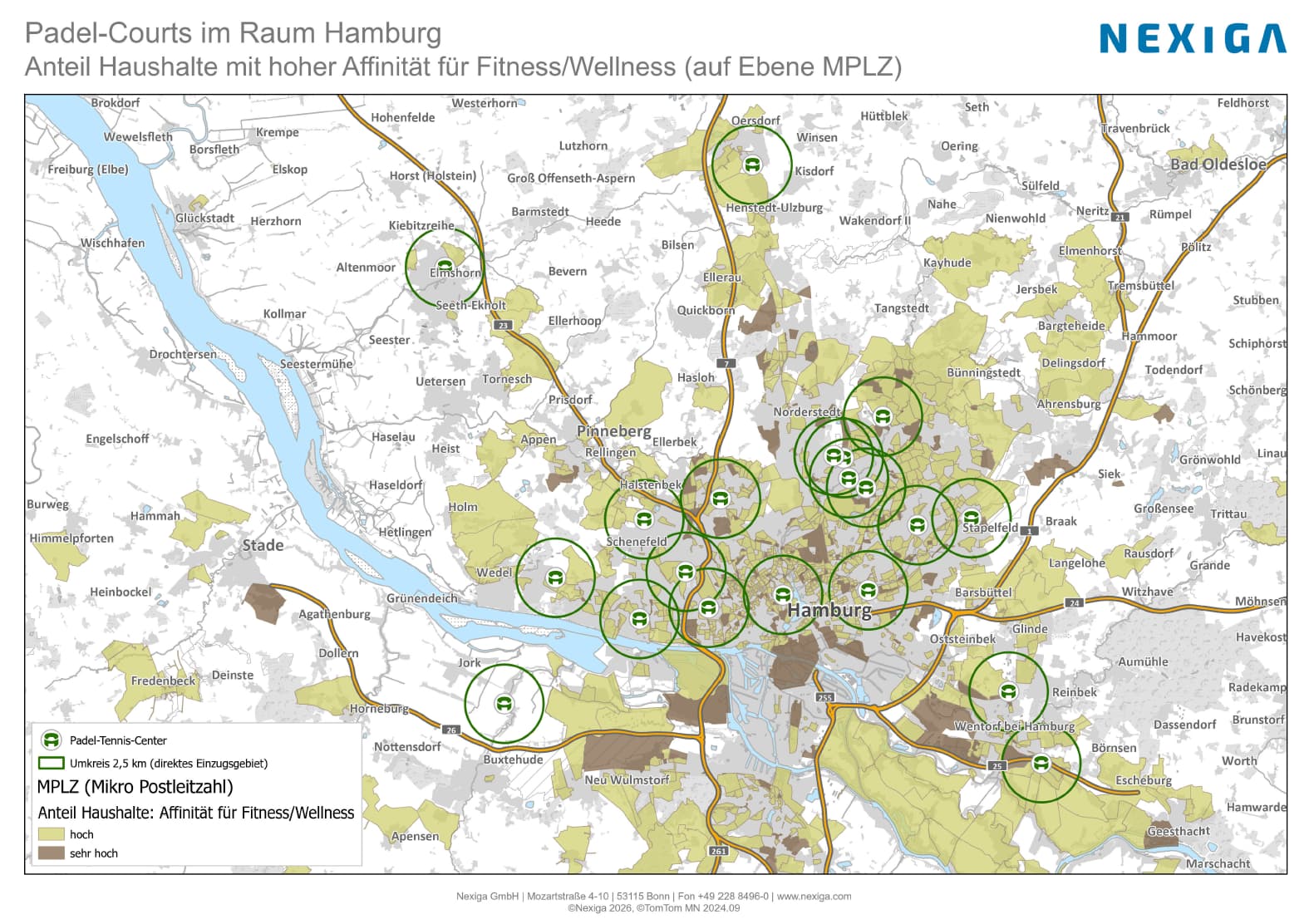
Our map (PDF) shows the current distribution of padel tennis facilities in and around Hamburg. In addition, the catchment areas of the courts are shown, as well as detailed Micro postal code (MPLZ) level, highlighting those neighborhoods where the proportion of households with a high affinity for fitness and wellness offerings is particularly high. These areas have above-average target group potential for padel tennis.
Origin and locations
If you want to try padel tennis in northern Germany, you can find it in Halstenbek, northwest of Hamburg, for example: at "Padel Amigos," you can easily join in and play. The name fits – because padel tennis has its roots in Mexico. At the end of the 1960s, an entrepreneur in Acapulco developed a smaller tennis court with walls due to lack of space – and thus created the basis for today's game.
In the 1970s, padel arrived in Spain, where the first courts were built along the Costa del Sol and the sport quickly gained popularity. Shortly thereafter, it spread to South America, particularly Argentina, where padel remains one of the most popular sports to this day. Padel is now a growing trend sport worldwide, attracting people of all ages.
If you would like to find out more about what's on offer in Germany, padelfinder.de provides a good overview—including regional figures on court density. This is particularly high in and around Hamburg, and northern Germany is generally well positioned, while North Rhine-Westphalia also boasts a rapidly growing range of facilities.
Impact on commercial real estate
The growing popularity of padel tennis is also providing new impetus in the commercial real estate segment. This new type of use is increasing demand for vacant warehouses and production halls in particular, as reported by Handelsblatt, among others. The most sought-after properties are those located close to cities and measuring between 1,500 and 5,000 square meters. In addition, existing tennis and squash centers are increasingly being converted, expanded, or modernized to integrate padel facilities.
This development comes at a time when the commercial real estate market in Germany is facing challenges across the board. Rising interest rates, inflation, and economic uncertainty are weighing particularly heavily on the office, retail, and parts of the logistics segments. Against this backdrop, data-based analyses are becoming increasingly important for project developers and investors. They enable a precise assessment of locations, properties, and their spatial environment—both for existing and planned projects in the sports and leisure segment.
-
Market data and analyses on demand enable opportunities and risks to be identified at an early stage, investment risks to be reduced, and economic potential to be tapped in a targeted manner—for example, as part of well-founded target group and location analyses.
-
Precise evaluation of locations, properties, and their spatial environment—both for existing and planned projects in the sports and leisure segment.
-
Advantages: The market data provided by Nexiga, including for the real estate industry, is comprehensive, high-quality, and relevant for decision-making. Among other things, it provides information on catchment areas and target groups, purchasing power, rental and purchase price structures, competitive POIs, traffic and pedestrian frequencies, and sociodemographic characteristics.